Search This Blog

Wednesday, November 26, 2025

MLCC Types Explained: General, HV, RF High-Q & Non-Magnetic

MLCC Design Guide
SMD Multilayer Ceramic Chip Capacitors (MLCCs)

A clear and practical breakdown of the four MLCC families engineers rely on — and how to pick the right type for your design.
Explore all MLCC series →

Multilayer Ceramic Chip Capacitors (MLCCs) sit at the core of almost every modern electronic design — from smartphones and EV inverters to RF front-ends, servers, sensors, and industrial controllers. But not all MLCCs behave the same. Dielectric systems, voltage structures, electrode materials and Q-factors dramatically change how a capacitor performs under real-world electrical stress.

This guide explains the four key MLCC types used today and when each one delivers the best performance.

  • JYS — General-Purpose MLCCs
  • JYT — High-Voltage MLCCs
  • JYU — RF / High-Q MLCCs
  • JYV — RF High-Q Non-Magnetic MLCCs

We also included a production-line walkthrough video for engineers evaluating manufacturing quality and process control.


1. JYS — General-Purpose MLCCs

Ideal for: decoupling, filtering, bypassing, oscillators, general signal conditioning
Dielectrics: NP0/C0G, X7R, X5R, X6S, X7S, Y5V
Size range: 0201 to 2225
Capacitance: pF to tens of µF

JYS is the widely used “workhorse” MLCC series. C0G/NP0 provides exceptional frequency and temperature stability, making it a preferred choice for timing circuits, filters and low-drift signal paths. X7R/X5R variants offer high capacitance density and solid reliability for power-rail decoupling and bulk bypassing.

Product page:
https://jbcapacitors.com/product/jys-smd-multilayer-ceramic-chip-capacitors/


2. JYT — High-Voltage MLCCs

Ideal for: EV inverters, LED drivers, SMPS, high-surge and transient-heavy nodes
Strength: reinforced ceramic layers and extended voltage robustness

JYT MLCCs handle voltage levels typically requiring larger film capacitors — but in a compact SMD form factor. These are built for high electric-field stress, repetitive surge pulses and environments where ripple and transient spikes are common. Engineers use HV MLCCs to reduce board real estate without sacrificing safety margins.

Product page:
https://jbcapacitors.com/product/jyt-smd-ceramic-chip-capacitors-high-voltage/


3. JYU — RF / High-Q MLCCs

Ideal for: RF filters, VCOs, impedance matching, resonant tanks, microwave applications

  • High Q factor for minimal energy loss
  • Low ESR at RF frequencies
  • Tight tolerance for predictable tuning

JYU MLCCs maintain stable capacitance and Q over RF and microwave frequencies, making them suitable for wireless modules, RF front-ends, satellite equipment and precision oscillators. The series is engineered to minimize phase distortion and thermal drift — critical for high-frequency design integrity.

Product page:
https://jbcapacitors.com/product/jyu-smd-high-q-rf-capacitors/


4. JYV — RF High-Q Non-Magnetic MLCCs

Ideal for: MRI coils, medical imaging, RF measurement instruments
Key advantage: zero magnetic interference

Standard MLCCs contain magnetic nickel electrodes. In MRI and precision RF systems, even small magnetic signatures can distort measurements or introduce image artifacts. JYV MLCCs eliminate this issue by using non-magnetic electrodes and terminations, ensuring signal purity and accurate RF performance.

Product page:
https://jbcapacitors.com/product/jyv-radio-frequency-high-q-non-magnetic-multilayer-chip-ceramic-capacitors/


MLCC Production Line — Full Video

Watch how MLCCs are produced — from tape casting and stacking to sintering, plating and AOI.


Which MLCC Should You Choose?

Application Recommended Series Reason
General decoupling / filtering JYS Broad dielectric selection and stable characteristics
High-surge power paths JYT High-voltage ceramic structure
RF matching & tuning JYU High Q, low ESR, RF-stable capacitance
MRI / precision RF JYV Non-magnetic design eliminates interference

Explore All MLCC Series

Find the best MLCC for your design or send us your BOM for tailored recommendations.

Looking for the right MLCC for your next project? Browse all ceramic capacitor categories or send your BOM for fast engineering support.

CTA (short): Find the right MLCC today

Monday, November 17, 2025

SMD MLCC & Thick Film Resistor Guide|General, High Voltage, RF, Automotive, High Power

Design Guide · SMD MLCC & Thick Film Chip Resistors

Surface-mount multilayer ceramic capacitors (SMD MLCCs) and thick film chip resistors appear in every modern PCB. Their interaction directly affects noise, EMC, stability, surge behaviour and long-term reliability. This guide explains how to choose jb MLCC + resistor combinations for general-purpose, high voltage, RF, automotive and high-power applications.

jb chip resistor promotional image for MLCC pairing, featuring general, high voltage, RF, and automotive applications

1. Why the MLCC + thick film resistor pairing matters

MLCCs lose capacitance under DC bias and temperature, while thick film resistors heat up under load or surge. These real-world effects change RC timing, filtering and impedance behaviour. Using matched jb components ensures alignment in derating, surge performance and qualification data.

2. Key application areas

2.1 General-purpose logic & control

General-purpose MLCCs provide decoupling; jb resistors set bias, pull-ups and timing constants.

2.2 High voltage rails

High voltage MLCCs handle dv/dt and EMI. High-value resistors discharge capacitors and divide DC buses.

2.3 RF & high-frequency

Low-loss MLCCs support matching networks; precision resistors maintain stable impedance and termination.

2.4 Automotive & harsh environments

AEC-Q200 MLCCs and anti-sulfur resistors withstand vibration, humidity and long-term stress.

2.5 High power & surge-intensive applications

Surge-rated resistors and ripple-capable MLCCs protect LED drivers, motor control and industrial power stages.

3. Quick selection checklist

  • Define RC role: decoupling, timing, sensing, snubbing or protection.
  • Select MLCC voltage with DC-bias derating (2× recommended).
  • Check resistor pulse-load and surge capability.
  • Review layout: creepage, clearance and thermal spacing.

4. Understanding real-world behaviour in MLCC + resistor networks

Most design issues appear not on the schematic, but on the PCB when components operate under real electrical and environmental stress. MLCC capacitance can drop by 40–80% under DC bias depending on dielectric type, case size and temperature. This reduction directly affects timing circuits, EMI filters and snubber networks, causing overshoot, ringing or emissions peaks during compliance testing.

Thick film resistors also behave differently under load. Power dissipation causes temperature rise, which shifts resistance value depending on TCR. For precision circuits—such as ADC networks, bias ladders or sensor conditioning—this drift can accumulate and push systems outside accuracy targets.

Selecting jb MLCC + jb resistors with aligned derating curves and pulse-load data enables accurate worst-case prediction instead of optimistic paper analysis, reducing redesign cycles and validation failures.

5. Layout practices that improve RC reliability

Even with correct components, PCB placement heavily influences performance. For high-speed and high-frequency nodes, reducing loop area between MLCC, resistor and IC greatly improves impedance stability. In high-voltage designs, proper creepage and clearance prevent partial discharge and long-term insulation degradation.

Mechanical stress also matters. MLCCs near board edges or mounting holes may crack under flex. jb MLCCs with robust terminations reduce this risk, especially when paired with resistors that limit surge energy.

  • Place MLCC as close as possible to IC pins.
  • Minimise lead length on resistors to reduce parasitics.
  • Use symmetrical layout for voltage-sharing resistor strings.
  • Maintain regulatory creepage/clearance on HV rails.

6. Designing for long-term stability & manufacturability

Industrial and automotive electronics require reliability under continuous stress. High-power supplies, EV modules, LED drivers and controllers may run 24/7 for years. In such cases, drift after 1,000–10,000 hours is more important than initial values.

jb MLCCs and resistors include load-life and humidity-bias data, allowing estimation of end-of-life performance. Matching MLCC voltage derating with resistor power derating ensures both components age consistently without creating single-point failure risks.

Manufacturing alignment is another advantage: consistent solder profiles and termination metallurgy across jb parts improve solder-joint reliability and minimise ESR/ESL drift after reflow.

7. When to choose alternative MLCC dielectrics or resistor types

While general-purpose MLCCs and thick film resistors cover many applications, specialised circuits need higher-grade components. RF networks use NP0/C0G for ultra-low loss, while precision filters rely on X7R for better stability under DC bias.

For resistors, thin-film options provide low TCR and tight tolerance. High-voltage dividers may require special film construction, and surge-heavy power circuits benefit greatly from jb’s pulse-rated resistor families.

  • NP0/C0G MLCCs → RF, oscillators, precision filters.
  • X7R MLCCs → general stable decoupling.
  • Thin-film resistors → precision analogue & measurement.
  • Surge-rated resistors → power supplies, motor drives, LED drivers.

8. Summary: A unified MLCC + resistor strategy improves design confidence

Treating MLCCs and resistors as a unified design block—not isolated components—helps achieve predictable, EMC-compliant and highly reliable performance. jb’s matched MLCC and resistor families offer aligned derating curves, consistent qualification data and strong manufacturability support across consumer, industrial, automotive and high-power designs.

Selecting the correct combination early greatly reduces redesign cycles, accelerates validation and enhances long-term product reliability.

Need help selecting the correct SMD MLCC + resistor combination?
Explore jb resistor families or contact us to get application support for your design.

Friday, November 7, 2025

JBR Series – High Power & Precision Components for Modern Electronics

jb capacitors brand header

Video Showcase: JBR Series – High Power & Precision for Modern Electronics

In industrial design and automation systems, resistors and potentiometers play a decisive role in power regulation, load balancing, and precise signal adjustment. The jb JBR Series combines high power wirewound technology with precision trimming control, delivering reliability under demanding thermal and electrical environments. Whether you’re building motor drives, power inverters, or measurement instruments, JBR ensures stability, repeatability, and long-term endurance.

High Power Wirewound Resistors and Precision Potentiometers – jb JBR Series industrial applications
Bridging high-power dissipation with precision control — jb JBR Series for industrial applications.

This video highlights how the JBR Series integrates high load capacity and precision adjustability to achieve better thermal balance, current stability, and fine-tuned resistance — essential for engineers designing efficient and stable power systems.

Within the series, JBR-BT, JBR-BS, and JBR-BQ models handle high surge and continuous dissipation for load banks and inverter systems, while JBR-BH and JBR-BJ provide fine resistance trimming for test equipment and control boards. For interface applications, JBR-BM, JBR-BN, and JBR-BP feature smooth rotational torque and digital knob operation, ideal for control consoles and instrument panels.

Related Videos

Video Title Focus Area
JBR High Power Wirewound Overview Thermal management, surge endurance, inverter test systems
Precision Potentiometers & Digital Knobs Signal calibration, analog control, panel adjustment
High reliability trimming potentiometers and wirewound resistors JBR Series industrial applications
High-reliability trimming potentiometers and wirewound resistors from JBR Series – built for engineering precision.

Learn more about jb’s JBR Series components designed for precision control, load management, and industrial stability.

Monday, October 27, 2025

jb® SMD Capacitors – Compact Design, Reliable Performance

SMD Aluminum Electrolytic | Low ESR | SMPS | DC/DC

Switch-mode power supplies and compact electronics require low ESR, optimized impedance, and long endurance in limited PCB space. jb® SMD Aluminum Electrolytic Capacitors are engineered for DC/DC converters, SMPS rails, LED drivers, and telecom equipment, delivering stable ripple suppression and robust power integrity with competitive total cost of ownership.

At a glance. Compared with standard radial capacitors, SMD types enable automated SMT assembly, support high-density layouts, and improve vibration tolerance and mechanical stability. These advantages translate into cleaner transients, lower self-heating, and more reliable operation across consumer, industrial, and networking platforms.

Why SMD Aluminum Electrolytic Capacitors Improve Power Integrity

In switching power architectures, ripple current flowing through the capacitor’s ESR converts to heat and shortens lifetime. Selecting low-ESR SMD capacitors reduces AC loss and temperature rise, which improves efficiency and minimizes undershoot/overshoot during load transients. Designers typically start from an allowable ripple target and derive an ESR budget using ESRmax ≈ ΔVripple / Iripple, then validate across frequency and temperature on the bench.

High-reliability SMD aluminum electrolytic capacitors for SMPS and DC/DC ripple control
High-reliability SMD electrolytics support low impedance across the SMPS switching band.

Series Overview and Typical Use Cases

Series Temp Load Life Target Features Main Applications
JCS 85°C 2000h Standard ESR Home electronics, cost-sensitive SMPS
JCK 105°C 1000–2000h Low ESR DC/DC, chargers, TV power boards
JCD 105°C 2000h Low impedance Telecom, PoE, networking gear
JCF 105°C 2000–5000h Ultra-low impedance LED drivers, industrial SMPS

Production Line Preview

See how jb® ensures consistent manufacturing quality and process control for SMD electrolytics.

Cross-Reference and Sourcing Continuity

jb® maintains a broad SMD lineup that maps to leading brands, enabling drop-in or spec-matched replacements to reduce supply chain risk. Request our cross-reference to accelerate qualification and secure stable production.

Always validate product selection with the official datasheet during design qualification. For high-temperature ambient above 60 °C, consider voltage derating.

Thursday, October 16, 2025

Low Leakage & Long Life Super Capacitors for Energy Retention


jb Super Capacitors are designed to deliver both ultra-low leakage current and long cycle life for applications in smart meters, IoT sensor nodes, memory backup systems, and industrial controls. They combine low ESR, stable voltage, and robust aging performance to ensure energy retention over extended periods.

Fundamentals of Low Leakage & Self-Discharge

Supercapacitors inherently exhibit self-discharge (leakage) due to ion migration, charge redistribution, and faradaic side reactions. Industry white papers report that leakage current typically decays with time (hours–days) and is temperature-dependent [1]. Modeling leakage with a parallel resistance in the RC network yields more realistic behavior predictions [2].

Recent studies analyze suppression mechanisms—Ohmic, Faradaic, and redistribution—and propose mitigation strategies [3]. Analytical, leakage-aware formulas further improve prediction of voltage–time curves under load [2].

Materials, Electrolytes & ESR Tradeoffs

Electrode, electrolyte, and separator choices impact both ESR and leakage. Reviews highlight that high ionic conductivity reduces ESR but impurities or side reactions can raise leakage [4]. Novel electrolyte systems and purification techniques aim to balance conductivity, stability, and leakage suppression [5].

Aging mechanisms matter: over time, capacitance may decrease while ESR rises. Elevated voltage or temperature accelerates degradation—binder breakdown, contact resistance growth, and electrolyte decomposition [6]. Long-life studies survey failure modes and durability pathways in supercapacitors [7].

Modeling & Lifetime Prediction

For design confidence, lifetime estimation is essential. Data-driven and physics-based models are used to forecast remaining useful life (RUL) [8]. Incorporating a leakage branch (parallel resistance) improves accuracy under partial states of charge and non-ideal conditions [2].

In practice, some standards and handbooks consider end-of-life when capacitance falls to ~70–80% of rated value or ESR doubles [9]. Robust designs aim to minimize leakage, maintain structural stability, and control internal heating across duty cycles.

Applications & Real-World Use Cases

  • Smart Meters / Grid — months-long retention without voltage drop.
  • IoT / Sensor Nodes — minimal self-discharge extends duty cycles and harvest intervals.
  • Memory & RTC Backup — preserve data during outages and cold starts.
  • Industrial / Automation — bridge transient loads and absorb regenerative pulses.

Hybrid battery–supercapacitor systems let the SC supply high-power spikes, reducing battery stress and extending battery life—common in EV and power electronics literature [10].

Demo Video

Transient load performance and ESR behavior during pulse discharge.

Open on YouTube

Hero Image

Supercapacitor overview – low leakage and long life
Overview: low leakage & long life supercapacitor architecture.

Series Gallery

Datasheets & Support for Design Engineers

Consult datasheets for ESR vs frequency, leakage current curves, lifetime modeling, and thermal behavior. Validate with system-level simulation to ensure leakage over months remains within thresholds. Our team can help you choose among coin, combined, and module types by voltage, temperature, and retention needs.

Explore Product Line Contact Engineering

References

  1. Vishay. How to Manage Leakage Current and Self-Discharge of EDLC Capacitors. 2025. PDF — supercapacitor self-discharge & leakage current control (Vishay)
  2. Ali, Z. M.; Calasan, M.; Aleem, S. H. E. A.; Hasanien, H. M. (2023). On the Exact Analytical Formulas of Leakage-Current-Based Supercapacitor Model Operating in Industrial Applications. Energies 16(4):1903 (MDPI). leakage-aware supercapacitor modeling (MDPI)
  3. Shang, W. et al. (2023). Insight into the Self-Discharge Suppression of Supercapacitors. review — mechanisms & suppression strategies (ScienceDirect)
  4. Dissanayake, K. et al. (2024). A Review of Supercapacitors: Materials, Technology, Challenges, and Applications. materials, ESR & leakage trade-offs (ScienceDirect)
  5. Mendhe, A. et al. (2023). A Review on Electrolytes for Supercapacitor Device. Springer. electrolytes & purification for low ESR / low leakage (Springer)
  6. Chen, X. et al. (2023). Aging and Degradation of Supercapacitors: Causes, Mechanisms and Prevention. open-access review — ageing under high V/T (PMC)
  7. Pameté, W. et al. (2023). The Many Deaths of Supercapacitors: Degradation, Aging, and Performance Fading. Advanced Energy Materials. PDF mirror — failure modes & durability (AEM)
  8. Yi, Z. et al. (2022). Prediction of the Remaining Useful Life of Supercapacitors: A Review. Hindawi. RUL models — data-driven & physics-based (open PDF)
  9. Wikipedia contributors. (updated). Supercapacitor — overview & typical EOL criteria (capacitance drop / ESR rise). supercapacitor fundamentals & end-of-life (Wikipedia)
  10. Vishay. Power Management Solution: Constant Voltage (CV) Pulse Charging of Hybrid Capacitors. Application Note, 2018. hybrid battery–supercapacitor systems & lifetime (Vishay)

Tuesday, October 7, 2025

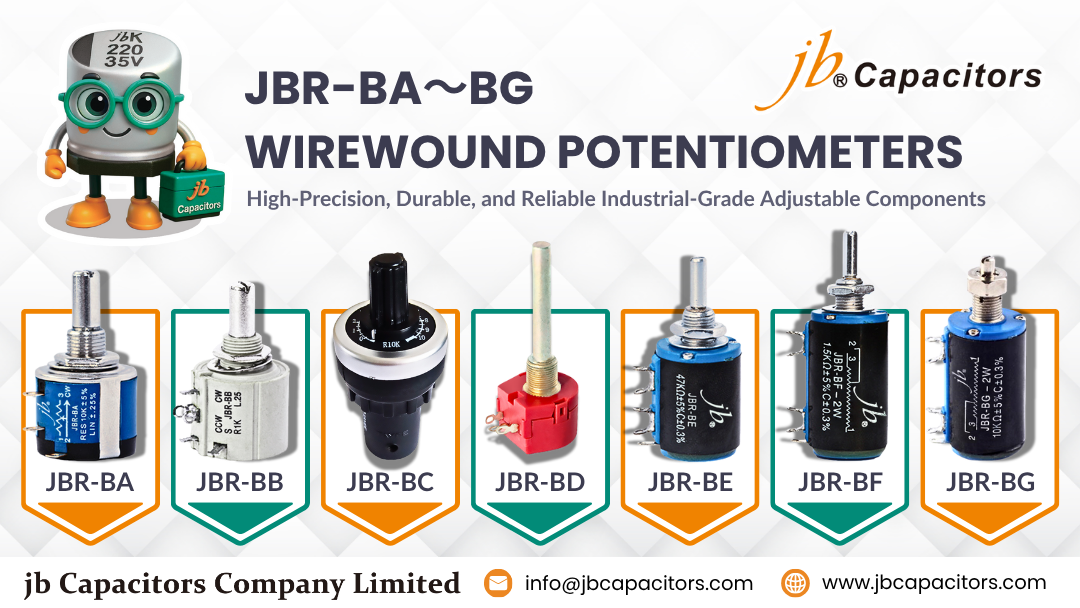
JBR-BA ~ JBR-BG Wirewound Potentiometer Explained – From Single to Multi-Turn Precision


Ever turned a potentiometer and wondered why some keep spinning while others stop after one twist?
That’s exactly the difference between single-turn and multi-turn wirewound types. The jb® JBR-BA ~ JBR-BG Series provides precise, stable adjustment across all applications—from quick manual tuning to fine industrial calibration.

Why Choose Wirewound Potentiometers?

Wirewound potentiometers use a coiled resistance wire instead of a carbon film. This construction ensures high accuracy, excellent heat stability, and minimal drift—ideal for measurement systems, audio tuning, and control panels that demand reliability.

Meet the JBR Series Family

The JBR-BA ~ JBR-BG family includes models from compact single-turn to precision 10-turn types. Below is a quick comparison for easier model selection:

SeriesTurnsPowerResistance RangeRecommended Application
JBR-BC1 Turn (Trimming)1 W50 Ω – 2 MΩPCB trimming, fine tuning
JBR-BD1 Turn1 W50 Ω – 10 kΩQuick panel adjustment
JBR-BE5 Turns1 W100 Ω – 47 kΩCompact control modules
JBR-BA / BB / BF / BG10 Turns2 W100 Ω – 100 kΩIndustrial calibration & automation
jb JBR-BA ~ JBR-BG wirewound potentiometers full series lineup showing industrial-grade adjustable models JBR-BA, JBR-BB, JBR-BC, JBR-BD, JBR-BE, JBR-BF, and JBR-BG – precision, durable, and reliable components by jb Capacitors

Video Demonstration

Frequently Asked Questions

Wirewound types are more stable, accurate, and durable under temperature and mechanical stress, ensuring consistent performance over years.

Yes, as long as your circuit accommodates more turns. The JBR-BG offers finer control for sensitive calibration points.

Yes. The JBR family offers multiple mounting and shaft options suitable for both front and rear panel installations.

You can contact us here — our team will respond within 24 hours.

Wednesday, September 24, 2025

Why Audio Engineers Choose JPX/JSX/JFX Capacitors


Video: JPX / JSX / JFX axial polypropylene film capacitors full series introduction for hi-fi DIY and audio engineers

Watch the JPX / JSX / JFX series introduction and learn why engineers choose these capacitors.

Reliable Alternatives Without Overspending

Engineers and DIY audio builders often face the same problem: high costs and strict order quantities when sourcing capacitors from well-known brands like Mundorf, Jantzen, or Auricap. The jb® JPX, JSX, and JFX series of axial polypropylene film capacitors solve this challenge by offering professional-grade audio performance with lower minimum order quantities and more accessible pricing.

JPX, JSX, JFX axial polypropylene film capacitors for audio amplifier upgrades and hi-fi crossover replacement

Official jb® product photo of JPX, JSX, JFX axial polypropylene film capacitors.

Technical Highlights

JPX Supreme stands out with detailed midrange, fast transient response, and stable low frequencies. JSX Superior offers a compact form factor with clean highs and strong mids, making it a favorite among DIY users. JFX Premium is designed as a cost-effective workhorse, combining reliability with low ESR and DF.

Practical DIY Applications

In real projects, one hobbyist reported a noticeable improvement after replacing crossover capacitors with JSX Superior 630V, describing a wider soundstage and clearer vocals. Another builder tested JPX Supreme in the signal path of a DIY headphone amplifier, noting enhanced bass control and a warmer midrange. These cases show how small-batch orders make it possible to experiment and refine designs without financial risk.

All information is based on jb® datasheets and field feedback.

Monday, September 15, 2025

How to Get Capacitor Quotes Online – jb Enhanced Quote List


Learn how to get capacitor quotes online in just 3 steps. Discover how jb Capacitors’ enhanced system helps engineers and global buyers get fast capacitor quotes from a trusted capacitor supplier.

FAQ: Getting Capacitor Quotes Online

Why use an online capacitor quote system?

Instead of sending multiple emails and waiting for replies, an online capacitor quote tool gives you faster, clearer results. With jb’s platform you can search, add to a Quote List, and submit in minutes.

Is this for engineers or procurement teams?

Both. Engineers can use precise filters to find the right part for BOM design, while procurement teams can consolidate multiple capacitor inquiries and track them in one place. It saves time and improves accuracy.

Does it support global sourcing?

Yes. jb is a global capacitor supplier, making the online quote system efficient for overseas buyers, distributors, and design engineers.

3 Easy Steps

1) Search Products Use filters like capacitance, voltage, ESR, or package in the capacitor search bar.
2) Add to Quote List Combine multiple items or alternatives in one radial capacitor inquiry form.
3) Get Fast Quotes Receive accurate capacitor quotes tailored to your BOM and sourcing needs.

Thursday, September 4, 2025

JNE, JNJ, JNK Snap-in Capacitors Datasheet & Applications

Accessing the right snap-in capacitor datasheet at the right time is critical for engineers. Delays in documentation often cause design interruptions and push back project timelines. To address this, jb® provides centralized resources for jb JNE capacitor, jb JNJ capacitor, and jb JNK capacitor – all with direct downloads and practical application examples.

▶ Watch Factory Process

Factory Video: See how reliability is built into every snap-in capacitor.

Centralized Datasheets for Engineers

Engineers no longer need to search across multiple sources for snap-in capacitor datasheets. All three jb® series are available in one place:

  • jb JNE capacitor – cost-effective, compact design, high ripple performance.
  • jb JNJ capacitor – extended lifetime, stable ESR, ideal for industrial power supply designs.
  • jb JNK capacitor – premium, long-life solution with excellent capacitor reliability.

Applications & Alternatives

The jb JNE, JNJ, and JNK series deliver reliable performance for SMPS, automation systems, EV chargers, and frequency converters. For engineers looking for second-source options, jb JNE is often compared as a Nichicon GL replacement or Yageo LG alternative, while jb JNK is used where high ripple capacitors and long service life are mandatory.

Why This Matters

Missing or outdated datasheets can cause costly delays in the design cycle. By providing immediate access to updated snap-in capacitor datasheets alongside real-world applications, jb® helps engineers streamline development, improve capacitor reliability, and reduce sourcing risks.

Download Datasheets & Contact

Download the latest datasheets and explore application examples for JNE, JNJ, and JNK series directly:

JNE, JNJ, JNK Snap-in Capacitors Datasheet & Applications

Application Overview & Series Comparison


Tuesday, August 26, 2025

Trimming Potentiometers vs. Leading Brands (PIHER / VISHAY / BOURNS)

Engineers comparing trimming potentiometers vs PIHER / VISHAY / BOURNS often need a clear, specification-first method to validate alternatives. This article focuses on what can be verified from datasheets—resistance range and tolerance, electrical travel, rated power and maximum operating voltage, mechanical life, and temperature performance—so you can make confident, documentation-backed decisions.

How to Compare — A Practical, Datasheet-First Method

Start by mapping your target model’s resistance value and tolerance to an equivalent option. Verify electrical travel and rotation angle to ensure comparable adjustment granularity; then confirm rated power and maximum operating voltage to maintain safety margins. Review mechanical life for expected cycling durability and check operating temperature range for reliability under your environmental conditions. Finally, match mounting/packaging (SMD vs. THT) and key mechanical dimensions for PCB layout fit.

Application Highlights

  • Wirewound Resistors — widely used in EV braking systems, energy storage modules, and industrial testing equipment due to their high power handling and reliability.
  • Digital Knobs — ideal for medical devices and precision instruments, providing clear mechanical display and accurate multi-turn adjustment.
  • Conductive Plastic Potentiometers — preferred in aerospace, medical electronics, and high-end industrial control where long life and high resolution are essential.
  • Carbon Film Potentiometers — cost-effective choice for audio equipment and household appliances, supporting the mass-market segment with stable performance.

In-House Manufacturing & Quality Control

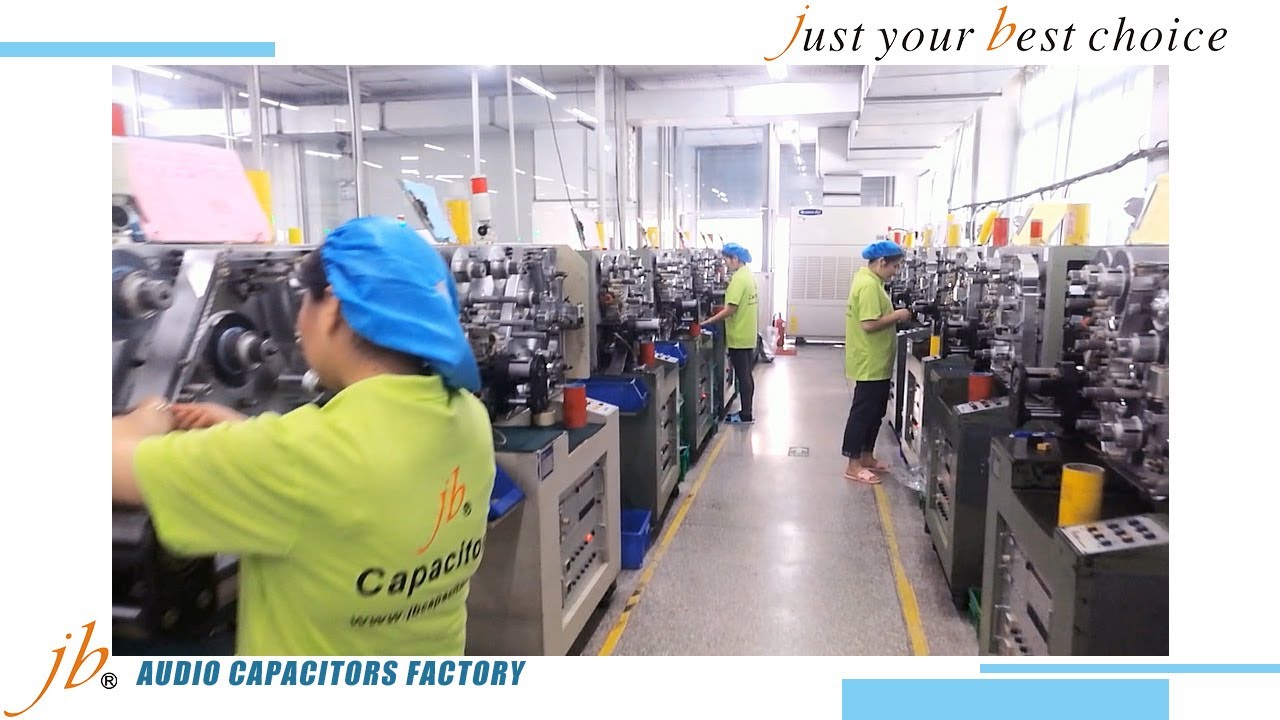
This video is not just a showcase — it demonstrates jb’s in-house manufacturing capability and strict quality control. By showing real production and adjustment processes, we give engineers confidence that every trimming potentiometer is built with consistent standards, from material handling to final testing.

This factory video highlights trimming potentiometer manufacturing and quality control testing. It shows how jb ensures stable performance, reliable adjustment, and consistent standards from production to final inspection.

From Evaluation to Action

If your spec-by-spec comparison aligns, proceed to sample testing and request a formal quotation. This ensures the final decision is grounded in both documentation and bench validation.

Conclusion

A datasheet-first approach keeps the comparison objective. Match resistance/tolerance, electrical travel and angle, power and voltage limits, mechanical life, temperature range, and packaging/fit. Validate on the bench, then move forward with samples and quotation.

Wednesday, August 13, 2025

JFQP – Reliable DC Link MKP Film Capacitors with Short Lead Time

In time-sensitive production environments, extended lead times for essential components can create significant challenges. For engineers and procurement teams, partnering with a dc link MKP capacitor supplier that can deliver within short cycles is often critical to keeping projects on track and reducing operational risk.

The JFQP series from jb Capacitors is designed with both performance and availability in mind. These capacitors provide dependable solar inverter capacitor solutions for renewable energy systems, as well as robust industrial DC link capacitor options for demanding motor drives and precision power supplies — all while being ready to ship within shorter timeframes.

The video above outlines the core features and practical use cases, showing how this high voltage MKP capacitor range can integrate into various power electronics designs. From improving DC bus stability in inverters to reducing ripple in industrial drives, the JFQP series meets technical requirements while maintaining availability.

👉 Explore JFQP Specifications
📩 Contact Our Team

JFQP DC Link MKP Film Capacitors – short lead time

Tuesday, August 5, 2025

jb JFG Series: Cycloidal & Flat Oval Designs for High Voltage Demands


In high voltage designs, structure matters. The way a film capacitor is built — whether in a cycloidal body or a flat oval form — directly affects not only how it fits your board layout, but also how it handles thermal expansion, electrical stress, and long-term reliability.

The jb JFG Series offers both options: JFGA / JFGC (Cycloidal) and JFGB / JFGD (Flat Oval). These designs are paired with polyester (PET) or polypropylene (PP) dielectric films, and come in ratings up to 1250VDC — making them ideal for energy-dense, mission-critical circuits.

So, which structure is right for your project?

If your layout needs a component with more height tolerance and compact footprint, the cycloidal version may be your best fit. On the other hand, if you’re working with space-limited vertical profiles or dense modules, the flat oval design will provide easier stacking and tighter spacing.

Both options offer excellent self-healing properties, low dissipation factor, and consistent dielectric performance across temperature and frequency ranges.

Compare Full Specs, Models & Drawings Online

Instead of guessing which model suits your voltage level or layout restrictions, we’ve made it easy for you to compare all JFG series models — including detailed dimensions, capacitance range, and lead types.

🔍 Compare all JFG models → Contact us for details

📐 Need to check fit and footprint? Full mechanical drawings and datasheets are available — request via our Contact Page.

📧 Questions? Contact our team here.

Thursday, July 24, 2025

JKA Series: Rare SMD Ceramic Trimmer Capacitors with Immediate Availability


In high-frequency design, precision and reliability are non-negotiable. From RF filters to impedance matching circuits, a capacitor that drifts under thermal stress or vibration isn’t just inconvenient — it’s a design flaw waiting to happen.

That’s why engineers increasingly choose the JKA Series SMD Ceramic Trimmer Capacitors from jb Capacitors. These aren’t your average variable capacitors. They’re crafted for high stability, high Q performance, and robust SMT compatibility, making them ideal for demanding designs across RF, telecom, IoT, and wearable applications.

What Makes the JKA Series Different?

Unlike traditional through-hole trimmers, the JKA Series features a miniature 3mm surface mount form factor — just 3.2 × 4.5 × 1.5 mm — that supports layout optimization in space-constrained PCBs.

Each model offers a tightly defined capacitance range from 1.5 pF to 28.5 pF, and supports multiple temperature coefficients: NPO, N750, and N1300. This gives engineers the flexibility to fine-tune circuits without compromising reliability.

Reliable in the Field, Not Just on the Bench

The JKA Series is built for real-world durability. Its sealed housing prevents flux and dust contamination, while its high-temperature liquid crystal polymer body ensures minimal dielectric loss and solid mechanical strength.

The adjustable torque (15–72 gf.cm) allows precise calibration that stays fixed. Whether in portable radios, wireless modules, or automotive subsystems, JKA capacitors hold their performance across challenging environments.

When to Choose the JKA Series

If your application requires stable tuning across temperature and time, especially in the 1 MHz to 100 MHz range, the JKA Series is the go-to solution.

Consider it for designs like:

  • Narrow-band RF amplifiers with fine impedance control
  • IoT sensors requiring compact layouts and clean signals
  • Filters needing stable response over thermal cycling

This is where high Q, low ESR, and minimal drift truly matter — and where jb’s JKA Series stands out.

Ready to Integrate?

Engineers worldwide rely on the JKA Series for high-precision analog and RF projects. Backed by a detailed datasheet and in-stock availability, it’s easy to spec into your next design.

Download datasheet and check availability → Click here

📧 Questions? Contact us here.